
Book Abstract
Is human philology really so useful that, as Friedrich Schlegel once claimed, “To live classically and to realize antiquity practically within oneself is the summit and goal of philology”? (WQ 2018) This positive view on human philology can be contrasted with an opposing one by Johann Wolfgang von Goethe, who warned that “it is always a sign of an unproductive time when it concerns itself with petty and technical aspects [in philology], and likewise it is a sign of an unproductive person to pursue such trifles”? (AZ 2018)
Contrary to these opposing views (and other ones as will be discussed in the book), human philology (in relation to eclecticness and non-eclecticness—as well as other dichotomies) is neither possible (or impossible) nor desirable (or undesirable) to the extent that the respective ideologues (on different sides) would like us to believe, such that there is no eclecticness without non-eclecticness (and vice versa), to be explained by the “formalness-informalness principle,” the “simpleness-complicatedness principle,” the “isolation-interaction principle,” the “functionality-nonfunctionality principle,” the “activeness-nonactiveness principle,” the “valuation-devaluation principle,” the “regression-progression principle,” the “absoluteness-relativeness principle,” the “inclusiveness-exclusiveness principle,” and other ones in “existential dialectics” (in Chapter Four).
Surely, this challenge to the conventional debate does not mean that human philology, as a field of study, is not significant, or that those diverse fields (related to human philology)—such as literary criticism, history, linguistics, philosophy, theology, social theory, ethics, aesthetics, political science, sociology, science, psychology, biology, information science, technological studies, cultural studies, science fiction, classics, and so on—should be ignored. (WK 2017) Of course, neither of these extreme views is reasonable.
Instead, this book offers an alternative (better) way to understand the future of human philology (and related fields) in regard to the dialectic relationship between eclecticness and non-eclecticness (and those in other dichotomies)—while learning from different approaches in the literature but without favoring any one of them (nor integrating them, since they are not necessarily compatible with each other). More specifically, this book offers a new theory (that is, the eclectic-noneclectic theory of philology) to go beyond the existing approaches in a novel way and is organized in four chapters.
This seminal project will fundamentally change the way that we think about human philology (in relation to the dialectic relationship between eclecticness and non-eclecticness—as well as those in other dichotomies) from the combined perspectives of the mind, nature, society, and culture, with enormous implications for the human future and what I originally called its “post-human” fate.s
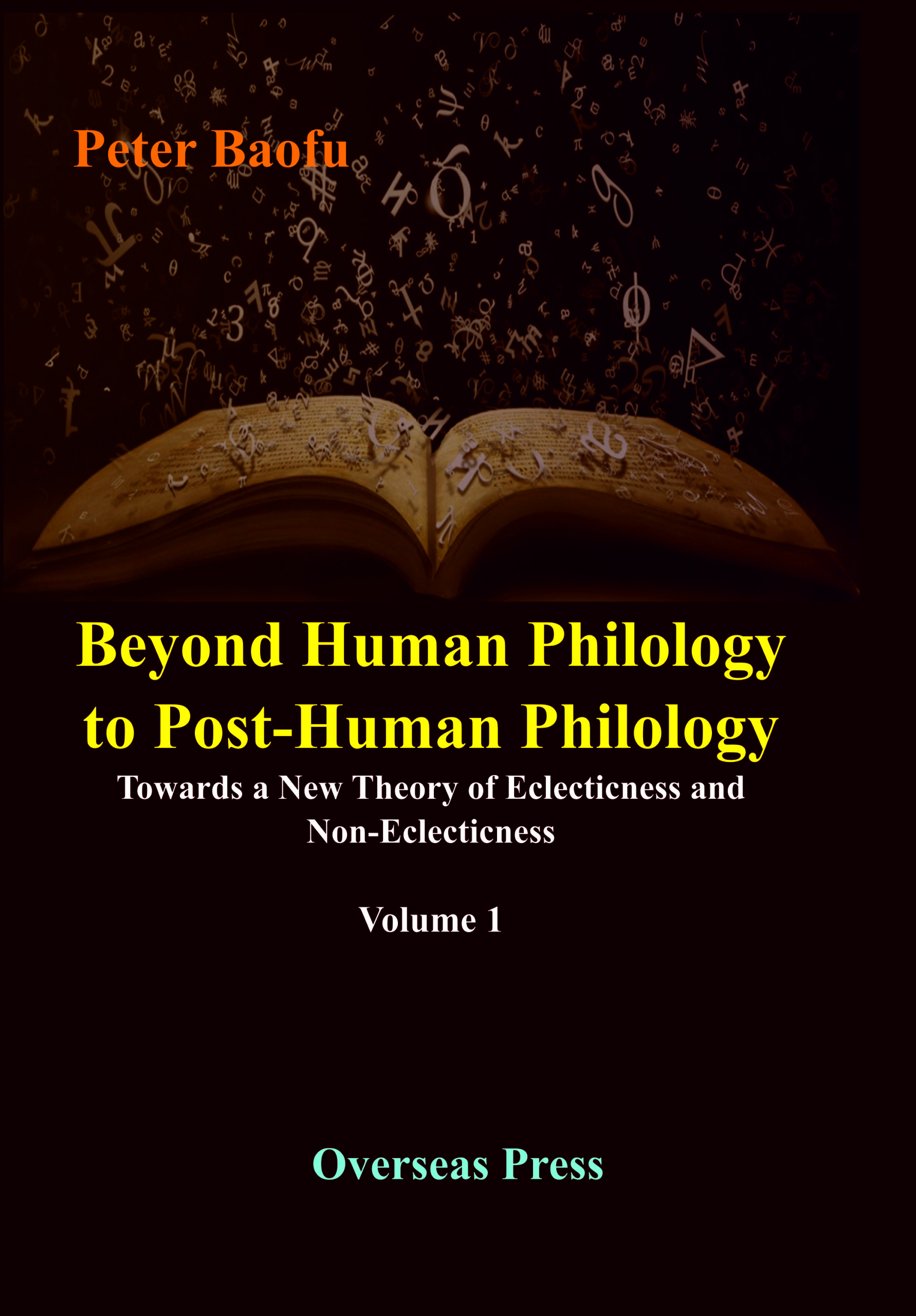
Beyond Human Philology to Post-Human Philology
Two Volume Set
Peter Baofu
₹3,995.00
Book Details
- Publisher: Overseas Press India Pvt. Ltd.
- Publication Date: 2019
- Language: English
- ISBN-13: 9788193836804
- Binding: Hardcover
- Edition: 1st Edition
Reviews
There are no reviews yet.