
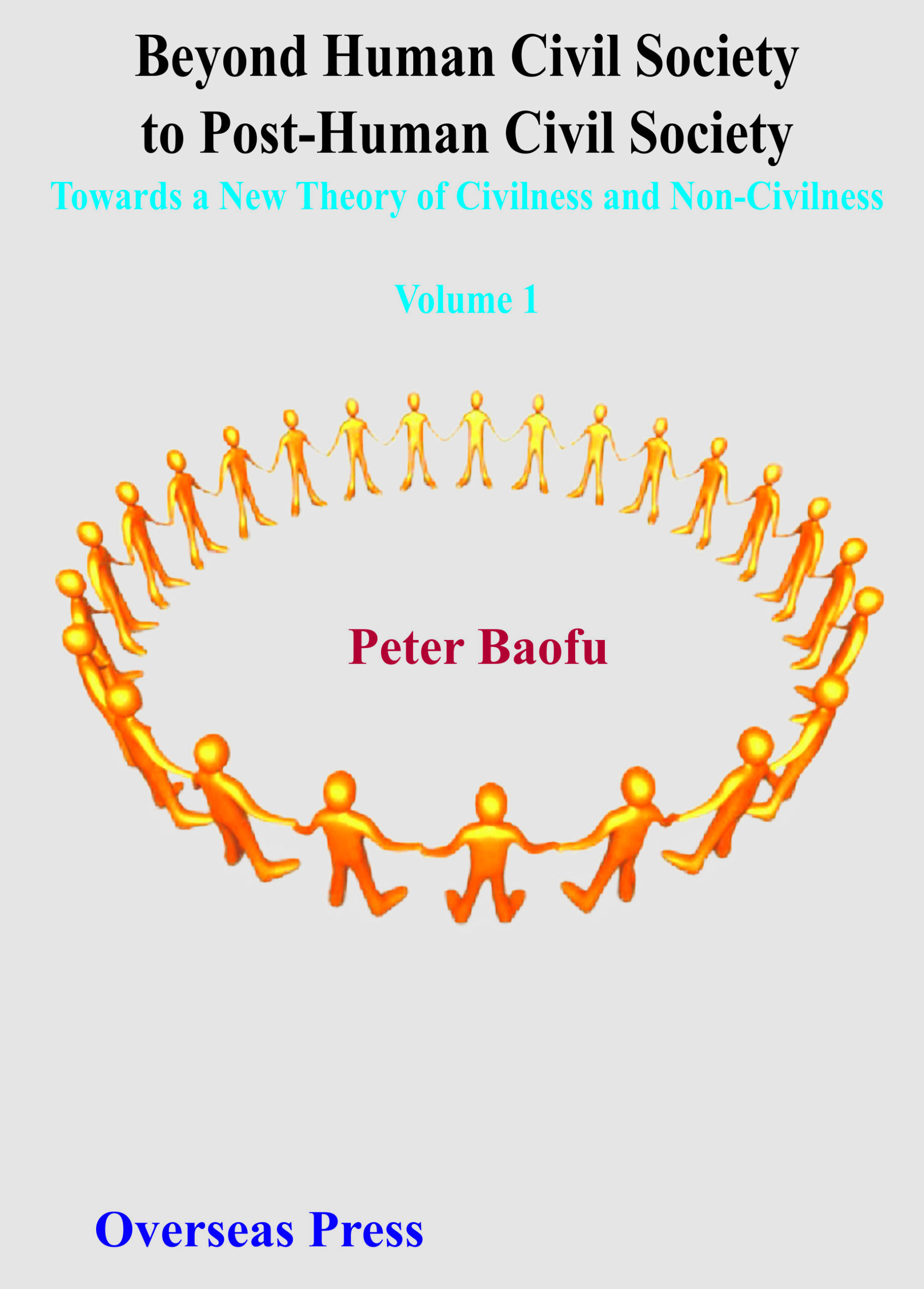
Book Abstract
Is human civil society really so promsing that, as Edmund Burke once claimed, “Justice is itself the great standing policy of civil society; and any eminent departure from it, under any circumstances, lies under the suspicion of being no policy at all”? (TE 2018) This positive view on human civil society can be contrasted with an opposing one by Geoff Mulgan, who cautioned us by asking: “So is civil society prepared for the future? Probably not. Most organisations have to live hand to mouth, juggling short-term funding and perpetual minor crises. Even the bigger ones rarely get much time to stand back and look at the bigger picture. Many are on a treadmill chasing after contracts and new funding.” (BQ 2018)
Contrary to these opposing views (and other ones as will be discussed in the book), human civil society (in relation to civilness and non-civilness—as well as other dichotomies) is neither possible (or impossible) nor desirable (or undesirable) to the extent that the respective ideologues (on different sides) would like us to believe, such that there is no civilness without non-civilness (and vice versa), to be explained by the “softness-hardness principle,” the “materiality-nonmateriality principle,” the “achievement-carefreedom principle,” the “inclusiveness-exclusiveness principle,” the “symmetry-asymmetry principle,” the “valuation-devaluation principle,” the “regression-progression principle,” the “absoluteness-relativeness principle,” the “violation-nonviolation principle,” and other ones in “existential dialectics” (in Chapter Four).
Of course, this challenge to the conventional debate does not mean that human civil society, as a field of study, is not significant, or that those diverse fields (related to human civil society)—such as economics, sociology, history, political philosophy, theology, social theory, ethics, psychology, biology, organizational studies, technological studies, cultural studies, classics, civics, and so on—should be ignored. (WK 2017) Surely, neither of these extreme views is reasonable.
Instead, this book offers an alternative (better) way to understand the future of human civil society (and related fields) in regard to the dialectic relationship between civilness and non-civilness (and those in other dichotomies)—while learning from different approaches in the literature but without favoring any one of them (nor integrating them, since they are not necessarily compatible with each other). More specifically, this book offers a new theory (that is, the civil-noncivil theory of civil society) to go beyond the existing approaches in a novel way and is organized in four chapters.
This seminal project will fundamentally change the way that we think about human civil society (in relation to the dialectic relationship between civilness and non-civilness—as well as those in other dichotomies) from the combined perspectives of the mind, nature, society, and culture, with enormous implications for the human future and what I originally called its “post-human” fate.
Reviews
There are no reviews yet.